

When a holiday home stands empty for months, the first visit of the season can start with airing out rooms and washing musty bedding. That used to be the case for the owner of a traditional country house on Saaremaa, an island in Estonia.
Built in the late 19th century, the house is used by the family for around six months each year. From October to March, it stands empty. Since installing a Sol Navitas solar air heating and ventilation system, the owner has noticed a difference in the springtime indoor conditions, lighting the stove and sleeping comfortably in summer.
Here, he shares his experience in his own words.
Indrek’s experience: the property, the problem, the solution and the results
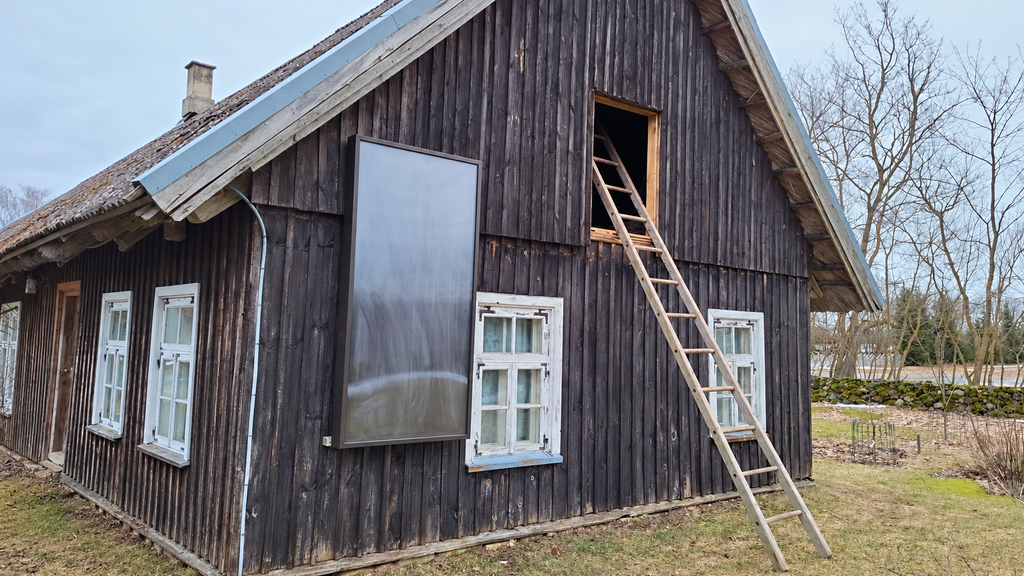
Property: A traditional Estonian farmhouse built in the late 19th century on the island of Saaremaa. It has no foundations in the modern sense. It does not retain heat well, making it difficult to keep warm in winter. Used as a holiday home for around six months a year, it stands empty from October to March. Ventilation relies on the chimneys serving two wood-burning stoves and natural airflow through gaps in the building.
The house and the problem
“Our house is an old country home with no foundations in the modern sense. It does not retain heat well, so keeping it warm throughout winter would be difficult.
Before the installation, ventilation relied on the chimneys of our two wood-burning stoves and natural airflow through gaps in the building.
During the months when nobody was there, the air became stale. Linen in the cupboards felt damp, and pillows and duvets developed a musty smell.”
The solution
The installed system combines a solar air heating collector with a fan, around 12 metres of insulated ducting in the attic and three adjustable air supply vents.
The controller allows the owner to set start and stop temperatures and choose between heating, cooling and ventilation modes. In this installation, cooling means bringing in cooler outdoor air at night.
What changed?
1. Dry, fresh air when we return in spring
“In spring, the rooms now feel dry and fresh. We no longer have to begin by airing out the rooms and bedding.
When we arrive, it is usually around 10°C warmer indoors than outside. If we want a little extra warmth, we can light the kitchen stove or the heating stove.”
The temperature difference is the owner’s observation in this particular house. Results depend on the building, weather and installation.
A heat pump can also warm the house and lower relative humidity as the air warms. However, a typical air-to-air heat pump recirculates indoor air; fresh outdoor air still needs to come through ventilation.
2. Low electricity use
“In our use, the system consumes much less electricity than our heat pump.
For safety, we switch off most of the electricity in the house over winter. Only the Wi-Fi for security monitoring and the ventilation remain powered on a separate small circuit.
The fan is rated at 150 W, and we can turn its output down further using the controller. Our winter electricity use is very low.”
3. Cooler nights in summer
“During very hot weather, the cooling mode is useful. At night, when it is cooler outside, the system brings that cooler air into the house. It is more comfortable to sleep, and the house feels cooler overall.
As the sun rises and the outdoor air warms up, ventilation switches off automatically. If we then avoid letting too much hot outdoor air in, the house stays pleasantly cool until evening.
You can get a similar effect by opening the windows at night, but that comes with mosquitoes — and in summer, you have to close the windows again at five in the morning…
A heat pump is certainly more effective for cooling. Well, you cannot be the champion at everything. Sometimes good enough is okay.”
This is night-time ventilation using cooler outdoor air. Its cooling effect depends on outdoor temperatures dropping sufficiently overnight.
4. Easier to light the stove
“After a long period without heating, the chimney is cold, especially higher up. When lighting the stove, smoke can come into the room because the draught does not establish immediately.
In our house, switching on the ventilation creates slight positive pressure indoors, and the draught gets going more easily.”
A solution fitted to the house
In this home, the system distributes solar-heated fresh air to three rooms. The owner also uses controlled ventilation to bring in cooler outdoor air on summer nights.
For a house that stands empty for part of the year, the main priority may be regular air exchange and a drier indoor environment. In a home used throughout the year, we also look at how the system works alongside existing heating and ventilation.
The right solution starts with the building and how it is used.
Does your holiday home smell musty or feel damp after months away?
Get in touch with Sol Navitas to discuss a solar air heating and ventilation solution for your home.