

Opening a window is often the first response to damp or stale indoor air. Sometimes it helps. At other times, particularly during humid weather, it can bring even more moisture inside.
Effective drying depends on more than ventilation alone. The incoming air should contain less absolute moisture than the indoor air, and the moisture it collects must be carried out of the building again.
Solar air heating makes this process more effective by warming the incoming fresh air before it enters the building.
Cooler air helps remove moisture
Relative humidity does not show how much water the air actually contains unless temperature is also considered.
At 20°C and 80% relative humidity, one cubic metre of air contains approximately 13.5 grams of water. At 10°C and the same relative humidity, it contains around 7.5 grams.
Both readings show 80% RH, but the cooler air contains considerably less water.
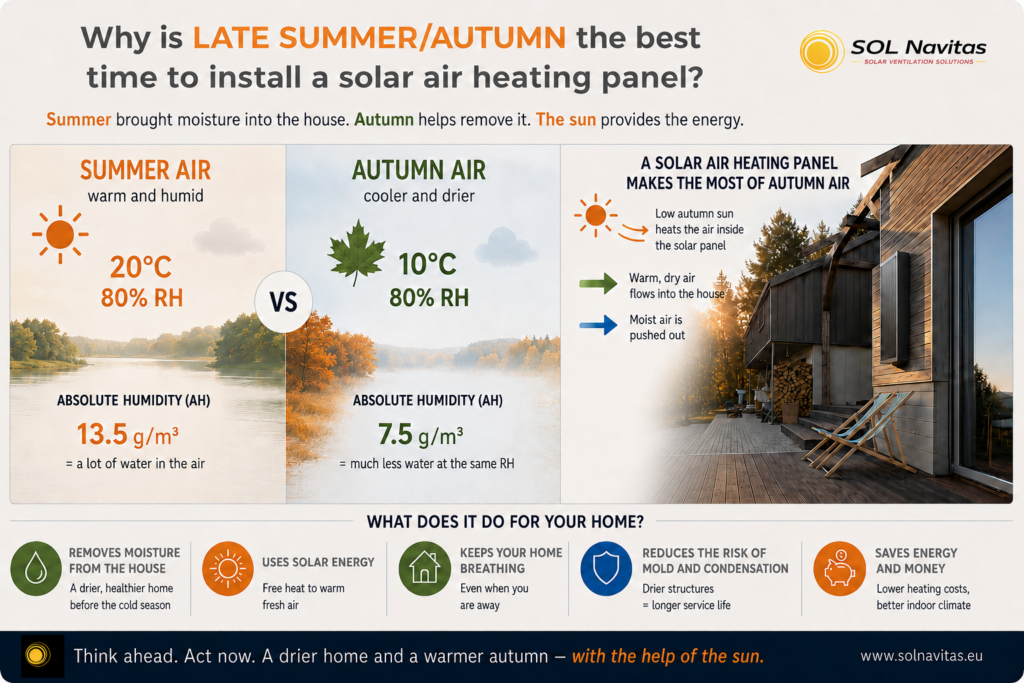
When that cooler air is warmed, its relative humidity falls even though its absolute moisture content remains the same. It can then take up moisture from walls, floors, furniture and other indoor surfaces.
Heating the air does not remove moisture by itself. Air exchange is equally important. Fresh, warmed air enters the building, absorbs moisture and displaces the more humid indoor air, which must have a route out.
The drying effect comes from combining suitable outdoor air, solar heat and continuous ventilation.
Opening a window is not always enough
An open window does not warm the incoming air or maintain steady airflow. It also works only while someone is there to manage it. If the outdoor air is warm and humid, opening the window may make indoor conditions worse.
A solar air collector draws in fresh outdoor air and uses sunlight to warm it before directing it indoors. As the temperature of the air rises, its relative humidity drops and its ability to absorb moisture increases. Continuous airflow then helps carry that moisture out of the building.
This is particularly useful in holiday homes, garages, workshops and other buildings that may remain unattended for long periods. Ventilation can continue whenever there is sufficient daylight rather than waiting for someone to arrive and open the windows.
Lower sun, better angle
Solar air heating is often associated with summer, but autumn can provide very good operating conditions.
As the sun moves lower across the sky, its rays reach vertically mounted, south-facing collectors at a favourable angle. At the same time, cooler outdoor air often contains less absolute moisture than it did during summer.
In Northern Europe, this creates an opportunity to remove summer moisture before winter. In Mediterranean climates, suitable conditions may continue through autumn, winter and spring.
Solar ventilation is a gradual process. It will not dry a building overnight or repair a leaking roof, damaged waterproofing or rising damp. What it can do is stop seasonal moisture from remaining trapped inside for weeks or months.
Sol Fresh combines fresh-air ventilation with solar air heating. Outdoor air passes through the collector, is warmed and then directed into the building. The solar heat reduces the energy otherwise needed to warm incoming ventilation air, while continuous airflow supports the removal of excess moisture.
A healthy building breathes
People need fresh air, but buildings need it too. Moisture trapped inside a structure can shorten the lifespan of materials, increase maintenance costs and create unhealthy indoor conditions.
A drier building is healthier, more comfortable and more durable. Seasonal sunshine provides a natural opportunity to help it breathe.
Could solar ventilation help your building?
Tell us where your building is located, how large it is and how it is used. We will help you find the solution that best suits your building.